Posts

Howdy!

Image
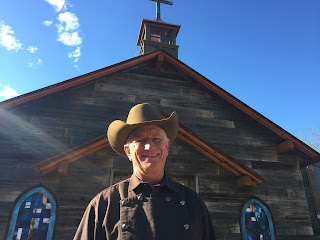
I often introduce myself this way: "Hi. I'm Steve, the Preacher at the Buffalo Chip Saloon in Cave Creek." People smile, but it's true. A few years ago, some friends and I decided it was time to have a church that fit right into our western community. So we began to meet at the Buffalo Chip Saloon. We meet outdoors. Some of us dress western-style. A few of us bring dogs. It's as casual and comfortable as sitting on your back porch. We like it that way. Our music is a mix of old and new, often with a bluegrass flavor, always with guitars and harmonica. We pitch it low enough for a guy to sing along without hitching up his pants, and simple enough to join in the first time you visit. We teach from the Bible. We believe that it tells the true story of God's loving rescue plan for the beautiful world he made. (It centers on Jesus, of course.) Oh, and because we meet at the Buffalo Chip Saloon, most people just call us "Church at the Chip." We...

Under the Broom Tree (1 Kings 19)

Image
Elijah had had enough. He was ready to quit.  After all, what more could he do? The nation was going down the tubes, and no one, not even God, seemed to care.  Exhausted, Elijah sat in the shade of a broom tree. It’s not like the Desert Broom in Cave Creek (an extremely objectionable weed/bush), but I associate them both just the same. It was merely a shrub, sometimes large enough to provide a bit of shade, but a pathetic place to find rest.  But rest was what he needed, and the broom tree would have to do. For a full day, he’d been running away from Queen Jezebel. It was a desert a lot like ours. He was hot. He was tired. He was hungry. Out of gas, out of ideas, and out of sorts. “I have had enough,” he said, and he went to sleep in what little shade he could find. Ever felt like Elijah? You have, you do, or you will. Sometimes, we’ve just had enough. We thought the plan was good, but nothing turned out right. We thought we’d have a reasonable conversation, but all we di...

Beauty out of Brokenness (2 Samuel 11)

Image
In a shocking series of events, King David, the one called "a man after God's own heart," was guilty of adultery and murder.  David had an affair with the wife of one of his best friends. When she became pregnant, he covered it up by having his friend killed on the battlefield. (You can read about it in 2 Samuel 11.) It is a sad and sordid story. His failure reminds us that even the best of us is capable of the worst of us. Every human being carries in himself or herself the highest aspirations and the lowest degradations possible. This truth is at the core of the biblical story: Humanity is beautiful; humanity is broken; humanity needs rescue.  There is only one Hero in the Bible. His name is Jesus, God-in-the-Flesh, the true Son of David. Troubling though it is, David's affair is a poignant reminder that God’s grace is generously given to all of us. Not a one of us is so low as to be beyond it, and none of us is so high as to be above it.  David’s failure reminds us...

Everybody Deserves Another Shot (2 Samuel 9)

Image
  Mephibosheth thought he was a dead man. But instead of a sentence of death, he received a new lease on life.  He was the grandson of King Saul, who, along with his father Jonathan, had died in battle fifteen years earlier. At the time, Mephibosheth was only five years old. Hearing the news, his nurse hurriedly gathered him up in order to flee to a safe place. After all, everyone knew what would happen next: the new king would kill all of Saul’s family in order to solidify his leadership. Unfortunately, in her rush to save the child, she was careless. She dropped him, and Mephibosheth was maimed for life (2 Samuel 4). Now he was not merely a refugee; he was a cripple. When we meet him a few chapters later, he is hiding in the land of Lo-debar, which means, fittingly, “a desolate place.” He is Saul’s only living relative, an orphan condemned to living a broken life in a barren place. That’s were we find him in 2 Samuel 9. David is well-established as the king of Israel. The wa...

A Man after God's Own Heart (1 Samuel)

Image
As the eighth son of Jesse, David's prospects were small.  When Samuel came in secret to anoint the next king of Israel from Jesse's family, David wasn’t even invited to meet the famous priest; he was left outdoors, tending to the sheep. Jesse's oldest son, Eliab, was brought before Samuel, who thought for sure he was the king God had chosen to lead Israel. After all, he was the first-born, nice looking, and tall of stature.  But God had other ideas. “Do not look on his appearance or on the height of his stature," he said, "because I have rejected him. For the Lord sees not as man sees: man looks on the outward appearance, but the Lord looks on the heart.”  One by one the sons were brought to Samuel, but the Lord rejected them all. Asked if he had any additional sons, Jesse responded in tones which must have sounded like this: “Well, there’s the runt of the litter; he’s out doing chores.” Like Cinderella, he wasn’t invited to the party.  But David was God’s man to...

Families of Hope (Ruth, 1 Samuel)

Image
When last we saw the children of Israel (in the book of Judges), they were in grave danger of losing their identity as God’s people. Even their national heroes had little regard for the God who had called them, rescued them, and returned them to their homeland. It is a pretty pathetic picture.  In contrast to this, the lovely little book of Ruth reminds us that even in the midst of national chaos, individual families were serious about following God. Ruth’s beautiful family story is followed by another family who refused to cave in to the chaotic culture around them. We meet them in the opening chapters of 1 Samuel: Their names are Elkanah and Hannah.  Like Ruth and Boaz before them, they were neither judges nor one of the priestly families. There was nothing special about them. But they were devoted to one another, to the God of Israel, and like Ruth, they had a child who would bring deliverance to Israel. Neither of these parents had any clue that their children would play s...

Here Comes the Judge (The book of Judges)

Image
I may as well admit it: Judges is my least favorite book in the Bible. The violence is depressing. The unfaithfulness of Israel is disheartening. The cycle of rebellion, slavery and rescue -- repeat -- is discouraging. Why is this book in the Bible? In part, it provides a chronological bridge between Joshua’s conquest and Israel's monarchy in 1 Samuel. In addition, it shows how desperately the people of God need the Ultimate Deliverer who will bring final salvation. But that doesn’t change the fact that Judges is a dark book. As much as we’d like to cheer for Left-handed Ehud, Daring Deborah, Mighty Gideon, or Strongman Samson, their victories do little to lighten the heart. In fact, many of the judges are scarcely better than the people they war against. We almost find ourselves longing for the days when they were wandering in hope of the Promised Land. The prescient warnings of Moses (in Deuteronomy) and Joshua (in Joshua 23-24) certainly hit their mark: Once safely in their inhe...

"Give me this Hill Country" (Joshua 14)

Image
When we meet Caleb in today’s reading, he is eighty-five years old. Forty years have passed since he was one of only two spies who insisted that the children of Israel could – and should – storm the Promised Land. (The other was Joshua, his current Commander-in-Chief.) Together with ten other spies they’d done a reconnaissance mission in preparation for their invasion into Canaan. As the Lord had promised, they discovered the land to be bountiful and beautiful. “It flows with milk and honey, and this is its fruit,” they said, displaying clusters of grapes so large that they carried them on poles between them (Numbers 13:23-27). It was a good land indeed– everything God had promised and more. At last, they had reached the Promised Land! Yes, there were fortified cities there. Yes, there were powerful people there. Some even called them “giants.” But hadn’t the Lord brought them out of Egypt, down to Mount Sinai, and over to Canaan in order to give them their ancestral land? Was not this...